
FAQ on Studies
General Questions
What is the Study Programme Committee?
The Study Programme Committee (SPC) is a formation that coordinates the study programme and supervises its implementation.
The goal of SPC is to ensure the relevance of the study programme, its accessibility, and the competitiveness of the study program by combining the opinions, needs, and good practices of interested parties.
Bachelor Study Programme Committees
Master Study Programme Committees
Where to find the Academic Calendar?
The Academic Calendar is here.
What should I know about the quality of studies?
The quality of studies depends on each participant:
- Student – is motivated to learn, interested in studies, inquires about study opportunities, expresses opinions and suggestions, when violations are noticed, submits complaints to the Dispute Resolution Commission or the Academic Ethics Commission.
- Lecturer – responsible for the study process, introduces students to the assessment, reporting procedures, etc.
- Students‘ Representation – represents, defends, and supports students' interests related to the quality of studies, at faculty and university councils, study programme committees, and other departments. If you wish to submit a complaint regarding a rating or a violation of a rating, you must fill out the form via your eStudent account.
- Study Programme Committee – ensures the relevance, accessibility, and competitiveness of the study program by combining opinions, needs, and good practices of interested parties.
- Studies Office – organizes and effectively administers the study process.
- Faculty and University Management – takes care of the resources needed for studies, prepares Faculty work plans, coordinates work processes between different work groups.
More information about the quality of studies here.
If you have complaints about the actions of academic community members working or studying in the department or the department's administrative staff that violate academic ethics, please get in touch with the Academic Ethics Commission. If you wish to submit a complaint regarding rating or procedural rating violation, in case of a dispute, please fill out the form via your eStudent account. More information here.
How can I register for the elective course?
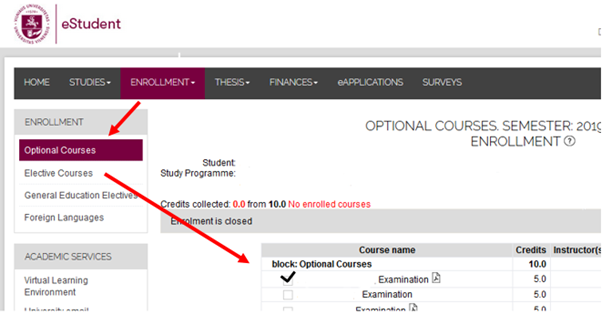
If the elective course is in your study plan, registration for the elective subject can be done online by logging into VU information system ▸ Enrollment ▸ Optional Courses. If the system does not provide any options or there are other obstacles to choose, please contact the Studies Office () to report any error that may have occurred.
When are diplomas awarded?
MIF graduates are awarded their bachelor's and master's degree diplomas every semester in February and June. The date, time, and location of the diploma award ceremony are announced on the faculty news website before the ceremony.
How do you obtain the certificate of study/study results?
Certificates of studies/study results, in Lithuanian or English, are issued by the Studies Office. You must order the certificate in advance by filling out the form via your eStudent account. The next day, you can pick up the certificate after ordering at the Studies Office, Room 106 or 108 (Naugarduko str. 24).
Please state in the notes, if:
- You wish to get the certificate via email;
- You need extra information in the certificate (eg, exam dates, holidays, etc.).
What to do to change the group?
Fill in the application in eRequests VU IS (https://is.vu.lt/) „for changing the current programme form, funding, group, and/or schedule“ before the beginning of the new semester. Indicate the group to which you want to be transferred and the important reason why. Note that a more convenient study schedule due to your work schedule is not considered an essential reason. If there are many applications to change the group, maintaining the balance of students in the groups is considered.
Who can fill out the document form about my studies provided by another institution (not VU)?
If you are currently a student, the MIF Study Department can fill out a document or part of a document in Lithuanian and/or English in the form specified by a Lithuanian or foreign institution. This service is charged.
In order for the MIF Studies Office to fill out the documents, you need to:
- pay €21.78 for the additional service "Completion of a request or its part according to the form specified by a Lithuanian or foreign institution about studies"
- Payment Code: 11000088
- Payment Deatils: for the issued certificate for (your Name Surname)
- Submit a “free-form request” via https://is.vu.lt (eRequests), specifying:
- that you are requesting the attached document to be completed,
- the reasons for your request, i.e., why you need this document,
- how you would like to receive the completed document: scanned by email or printed and collected in person; whether or not you need the signature of a MIF employee, faculty stamp, etc.
- Attach two documents to this eRequest in the system:
- the document issued by the other institution, which you request to fill in,
- the payment receipt confirming that you have paid for the service.
- Submit in VU IS a Request. In it, mention the form you need to complete, motivation (for what purposes you need the request), and the way you want to receive it (printed with signature and stamp, or sent via e-mail).
- Attach a form you need to complete and a payment order.
Who owns the software code/computer program/database I created: me, the company, or VU?
According to the current Regulations on Intellectual Property Management of Vilnius University (LT only), property rights to computer programs and databases created by students are permanently transferred to VU if they were created using the experience, financial support, equipment, materials, premises, or other property of VU, unless it is specified otherwise in the contract. The personal non-property rights of the authors belong to the authors of the program code/computer program/database, indicating the name(s) of the author(s) (copyright).
A student who has created a program code/computer program/database during his/her studies and intends to commercialize such a copyrighted object must inform his/her supervisor.
A license or other agreement must be signed to commercialize computer programs, program codes, and data. In such a case, you should contact the VU Innovations Department by e-mail .
What should I do if I reasonably think my work has been unfairly graded because of the fault of the lecturer?
In this case, we suggest submitting a complaint (plea) via the VU Students Information System: Student -> e.Application -> Complaint, plea -> Complaint (Plea) to the Dispute Resolution Committee of the Faculty.
The complaint (plea) must state:
- Applicant‘s name, surname, main study programme, email address provided by Vilnius University, telephone number*;
- Name of the study subject (module), lecturer(s), and the type of complaint (plea) (whether it is filed due to the final assessment, the procedural violation, or both);
- Base for the complaint (plea) (circumstances, justifying the applicant‘s disagreement with the final assessment or the specific violation of the procedure);
- Specific applicant‘s complaint (plea) (e.g., to change the final assessment to provide an opportunity to retake the exam, etc.);
- Applicant‘s signature, when the complaint (plea) is filed not via the Information System of Vilnius University (VU IS)*.
*Necessary to indicate if the complaint (plea) is filed not via VU IS.
For more information, please visit the Faculty Commission section of the MIF website.
What should I do when registering my LSIC I get information that the data about my studies is missing?
The most common mistake made during registration of LSIC is that a foreign student, while creating an LSIC account, provides the personal ID number from the temporary residence permit card in Lithuania. Please note that you can find the required ID number in your VU IS eStudent account. After logging in, click on your name in the upper right corner and view the required number in the Personal Data section – it is called the Identification Code. You should use this code during the registration of LSIC.
For other questions regarding LSIC please contact them by email .
How to reserve a MIF classroom?
First, you need to check the classroom schedule system to see if the desired classrooms are available during the required period. The student responsible for the upcoming event(meeting, occasion, etc.) must fill out a free-form application via eStudent at least 5 work days before the event date. The request must specify:
- the name and purpose of the event or occasion;
- the requested lecture hall (room), address, date, and time*;
- identify yourself as the person responsible** and confirm that you will ensure the premises are tidied up after use and that you will take responsibility for any material damage caused.
Explanation:
* Choose the premises and time optimally: you can specify several premises at different times in one request, but if the reservations for the same day are very similar, e.g., 6:00 p.m. to 10:00 p.m. and 5:00 p.m. to 11:00 p.m., it is worth combining them and booking all of them from 5:00 p.m. to 11:00 p.m.
** Only you can be specified as the responsible person, i.e., you cannot specify another student.
What should I do if my LSIC stops working as a key when trying to enter the MIF building/library after working hours?
The Lithuanian Student Identity Card (LSIC) is a student key that unlocks the exterior doors of MIF buildings and the library after working hours and on weekends. MIF buildings have spaces that students can use 24/7.
If the LSIC stops working as a key for the exterior doors of MIF buildings and the library, students should contact the MIF Study Office by email at and arrange a time and place to come in person with their LSIC so that the card code can be scanned. The issue will then be forwarded to VU IT specialists, and once it is resolved, the Study Office will inform the student via the VU-provided email address.
Exams, Midterms, and Academic Debts
What should I do if I get sick during the exam?
Suppose a student cannot take the exam at the time specified in the schedule due to illness or another important reason, the student must inform the MIF Studies Office and the subject lecturer about the reason for the absence within three working days after the due date. They must also submit a request to postpone the exam in their eStudent account and attach proof documents. The exam must be organized no later than 1 month from the start of the new semester.
What should I do if I miss a test or another midterm exam?
Suppose a student cannot attend the midterm assessment (test, project presentation, etc.) at the scheduled time due to illness or another important reason. Within three working days after the assessment date, they should inform the MIF Studies Office about the reason for absence at and attach documents proving the reason. Also, inform the lecturer and agree on an assessment at another time.
I probably won't pass the elective course I'm currently studying. Can I repeat the course and replace it with another one next semester?
Yes, but you will need to submit an unclassified student agreement rather than a repeat request. This is because the repetition request must be submitted no later than 14 days before the start of the new semester, but at that time you will not formally have a debt – it will only appear after the retake period has ended. For example, after the retake period, the debt will appear in mid-February, so there will be no basis for accepting your request to retake the course in mid-January. To conclude a unclassified student agreement please contact the study office of thet faculty which subject you wish to study by September 1 or February 1. Once you have passed the exam for that subject, submit a request to VU IS to have the subject credited instead of the debt.
When do exam retakes take place?
If the final exam result does not reach the required level of study achievements, the student may retake it one time during the first two weeks of the new semester. Retake schedules are published on the VU MIF timetable (it is necessary to select the schedules of the previous semester). If the retake date has not been published, the student should notify the Studies Office before the new semester begins.
How to eliminate an academic debt?
A debt is recorded if a student fails a retake of a study subject exam (receives a grade lower than 5). There are three options for eliminating the debt
1. REPETITION OF COURSE SUBJECT.
The student attends the subject classes together with the students of the lower year, individually coordinating the schedule. For the subject repetition to be credited, it is necessary to submit a repetition request (VU IS) and indicate the subject that you will repeat in the request. Application deadlines.
When the request is completed, an order for the subject repetition and the amount payable for the subject repetition will be visible in your student account. You should pay it within the first month of the new semester.
2. RETAKE OF COURSE SUBJECT UNDER THE EXTERNAL PROCEDURE
First, the student must check whether it is possible to take the course as an extern. After submitting a request to repeat the course as an extern via VU IS and having the request approved, the student's account will display an order to repeat the course and the amount payable for repeating the course. This must be paid within the first month of the semester. Students study the course independently and only attend mid-term assessments and exams/retakes. Application deadlines.
3. CHANGING ONE COURSE SUBJECT TO ANOTHER (only in case of general university studies, optional studies, or individual studies).
If a general university studies/optional/individual studies subject is no longer offered or thereare other important reasons, the subject can be replaced with another. After individually coordinating the schedule, the student attends the subject classes with students of a lower year or another study program. For the repetition of a subject to be credited, it is necessary to submit a repetition request via VU IS and indicate in the request which subject you would like to replace with what subject. Application deadlines.
A student who repeats a subject, repeats the subject for the first time under the external procedure after independent repetition or replaces the subject with another subject, and fails the retake, is recorded with an academic debt, which is eliminated using analogous debt elimination methods.
What should I do if I have academic debt and am in the final semester?
A consolation session may be organized for the final-year students. This is an opportunity for students to retake the exam one more time before submitting their final thesis, so they can successfully complete their studies. At the beginning of the semester, students should contact their teacher, arrange a possible time, and notify the Studies Office (). The consolation session occurs each year: in the fall semester, during the first two weeks of December, in the spring semester, during the first two weeks of May.
What is the external procedure?
External procedure – a student, unclassified student, is independently studying individual study courses (modules) and taking exams (credits) for these study courses (modules). Such a student does not have the right to attend lectures, exercises, laboratory work, and other practical classes. Retaking a study course (module) under an external procedure is permitted if the course (module) is not included in the list of study courses (modules) that cannot be studied under an external procedure.
Essential aspects:
- Application for taking an exam under an external procedure must be submitted no later than 1 month from the start of the new semester via VU IS eRequest.
- The fee must be paid by October 1 (autumn semester) / March 1 (spring semester);
- The student should attend the first contact lesson of the subject and find out all the necessary information for the successful completion of the subject. It is also essential to follow the subject description.
A student or unclassified student with external status is allowed to take the exam/credit twice (exam and retake). In case of failure, the subject course must be repeated; otherwise, the application for an external procedure will be rejected.
Which study subjects can I retake under an external procedure after independent repetition, or replace with another?
Select your study program below to find out which subjects you can retake under an external procedure or replace with another. Once selected, pay attention to the explanations of the symbols and abbreviations.
Bachelor studies
Information Technologies
- Yes – no restrictions.
- Yes* – possible to retake the course unit under an external procedure, if it complies with the conditions for the external procedure stated in the course unit description. Before applying for an external procedure, the student must check the course unit description.
- Course type: CC – compulsory course, IS – individual studies.
|
Semester |
Course Unit |
Type |
Is it possible to retake the course unit under an external procedure |
Is it possible to replace the course unit with another when repeating the course |
|
1
|
Discrete Mathematics
|
CC
|
Yes*
|
No
|
|
1
|
Introduction to an IT Career
|
CC
|
Yes*
|
No
|
|
1
|
Mathematics for Informatics I/II
|
CC
|
Yes*
|
No
|
|
1
|
RISC Computer Architecture
|
CC
|
Yes*
|
No
|
|
1
|
Basics of Programming and IT
|
CC
|
Yes*
|
No
|
|
2
|
Data Structures
|
CC
|
Yes*
|
No
|
|
2
|
Mathematics for Informatics II/II
|
CC
|
Yes*
|
No
|
|
2
|
Object-Oriented Programming
|
CC
|
Yes*
|
No
|
|
2
|
UNIX Operating Systems
|
CC
|
Yes*
|
No
|
|
3
|
Database Management Systems
|
CC
|
Yes*
|
No
|
|
3
|
Software Engineering
|
CC
|
Yes*
|
No
|
|
3
|
Basics of Virtualization
|
CC
|
Yes*
|
No
|
|
4
|
Data Analysis, Data Networks, and Visualization
|
CC
|
Yes*
|
No
|
|
4
|
Web Programming
|
CC
|
Yes*
|
No
|
|
4
|
Human-Computer Interaction
|
CC
|
Yes*
|
No
|
|
5
|
Computer Networks
|
CC
|
Yes*
|
No
|
|
6
|
Software Architecture
|
CC
|
Yes*
|
No
|
|
6
|
Advanced Topics in Information Security
|
CC
|
Yes*
|
No
|
|
6
|
Network Security
|
CC
|
Yes*
|
No
|
|
Autumn/Spring
|
Problem-based Project
|
IS
|
Yes
|
Yes
|
|
Autumn
|
Geometric Applications for Informatics
|
IS
|
Yes
|
Yes
|
|
Autumn
|
IT Service Management
|
IS
|
Yes
|
Yes
|
|
Autumn/Spring
|
Programming for Windows.NET
|
IS
|
Yes
|
Yes
|
|
Autumn/Spring
|
Service Management
|
IS
|
Yes
|
Yes
|
|
Spring
|
Internet Application Penetration Testing
|
IS
|
Yes
|
Yes
|
|
Spring
|
Computer Networks for Professionals
|
IS
|
Yes
|
Yes
|
|
Spring
|
Mainframe Technologies
|
IS
|
Yes
|
Yes
|
Master studies
Informatics
- Yes – no restrictions.
- Yes* – possible to retake the course unit under an external procedure, if it complies with the conditions for the external procedure stated in the course unit description. Before applying for an external procedure, the student must check the course unit description.
- Course type: CC – compulsory course, OC – optional course.
|
Semester |
Course Unit |
Type |
Is it possible to retake the course unit under an external procedure |
Is it possible to replace the course unit with another when repeating the course |
|
1
|
Artificial Neural Networks
|
CC
|
No
|
No
|
|
1
|
Data Analysis
|
CC
|
No
|
No
|
|
1
|
Scientific Research Work I/III p.
|
CC
|
No
|
No
|
|
2
|
Scientific Research Work II/III p.
|
CC
|
No
|
No
|
|
2
|
Modelling and Verification of Software-based Systems
|
CC
|
Yes*
|
No
|
|
3
|
Scientific Research Work III/III p.
|
CC
|
No
|
No
|
|
3
|
Professional Practice
|
CC
|
No
|
No
|
|
1
|
Electronic Signature Infrastructure and Electronic Documents
|
OC
|
Yes
|
Yes
|
|
1
|
Heuristic Algorithms for NP-complete Problems
|
OC
|
No
|
Yes
|
|
1
|
Intellectual Systems
|
OC
|
Yes*
|
Yes
|
|
1
|
Methods of Cryptography
|
OC
|
No
|
Yes
|
|
1
|
Object Databases
|
OC
|
No
|
Yes
|
|
2
|
Multidimensional Data Visualization
|
OC
|
No
|
Yes
|
|
2
|
IT Projects Management
|
OC
|
No
|
Yes
|
|
2
|
User Experience Engineering
|
OC
|
No
|
Yes
|
|
2
|
Object Oriented Technologies
|
OC
|
No
|
Yes
|
|
2
|
Software process Assessment and Improvement
|
OC
|
No
|
Yes
|
|
2
|
Randomized Algorithms
|
OC
|
Yes*
|
Yes
|
|
2
|
Selected Topics in Coding Theory
|
OC
|
No
|
Yes
|
|
3
|
Graphics and Visualization Methods
|
OC
|
No
|
Yes
|
|
3
|
Distributed Systems
|
OC
|
No
|
Yes
|
|
3
|
Cloud Computing
|
OC
|
No
|
Yes
|
|
3
|
Software Systems Architecture and Design
|
OC
|
No
|
Yes
|
Computer Modelling
- Yes – no restrictions.
- Yes* – possible to retake the course unit under an external procedure, if it complies with the conditions for the external procedure stated in the course unit description. (To take the course unit "Programming in Cloud Computing" exam under an external procedure is possible only if a minimal amount of obligatory scores (2 scores) is already collected from the practical part.)
- Course type: CC – compulsory course, OC – optional course.
|
Semester |
Course Unit |
Type |
Is it possible to retake the course unit under an external procedure |
Is it possible to replace the course unit with another when repeating the course |
|
1
|
Spatial Databases
|
CC
|
Yes
|
No
|
|
1
|
Cybersecurity Technologies
|
CC
|
No
|
No
|
|
1
|
Methods of Cryptography
|
CC
|
Yes
|
No
|
|
1
|
Methods of Nonlinear Modelling
|
CC
|
Yes
|
No
|
|
2
|
Data Analysis
|
CC
|
Yes
|
No
|
|
2
|
Deep Learning
|
CC
|
Yes
|
No
|
|
2
|
Scientific Research Work
|
CC
|
No
|
No
|
|
2
|
Signal Analysis and Processing
|
CC
|
Yes
|
No
|
|
1
|
Programming in Cloud Computing
|
OC
|
Yes*
|
Yes
|
|
1
|
Computational Geometry Algorithms
|
OC
|
No
|
Yes
|
|
1
|
Digital Forensics
|
OC
|
No
|
Yes
|
|
2
|
Multidimensional Data Visualization
|
OC
|
No
|
Yes
|
|
2
|
Information Security Management
|
OC
|
No
|
Yes
|
Data Science
- Yes – no restrictions.
- Yes* – possible to retake the course unit under an external procedure, if the student complies with the conditions for the external procedure stated in the course unit description. Before applying for an external procedure, the student must check the course unit description.
- Yes** – possible to change to other optional course of the same study programme of the same semester. In order to change to optional course of other study programmes, it is necessary to coordinate with the Study Programme Committee and the subject lecturer.
- Course type: CC – compulsory course, OC – optional course.
|
Semester |
Course Unit |
Type |
Is it possible to retake the course unit exam under external procedure |
Is it possible to replace the course unit with another when repeating the course |
|
1
|
Multivariate Statistics
|
CC
|
Yes*
|
No
|
|
1
|
Data Mining
|
CC
|
Yes*
|
No
|
|
1
|
Parametric and Nonparametric Statistics
|
CC
|
No
|
No
|
|
1
|
Natural Language and Speech Processing
|
CC
|
No
|
No
|
|
1
|
Panel Data Econometrics
|
OC
|
No
|
Yes**
|
|
1
|
Game Theory
|
OC
|
Yes*
|
Yes**
|
|
1
|
Modern Mathematical Economics
|
OC
|
No
|
Yes**
|
|
1
|
Digital Image Processing
|
OC
|
No
|
Yes**
|
|
1
|
Microeconomic Analysis
|
OC
|
No
|
Yes**
|
|
2
|
Functional Data Analysis
|
CC
|
Yes*
|
No
|
|
2
|
Big Data Analysis
|
CC
|
Yes
|
No
|
|
2
|
Bayesian Statistics
|
OC
|
Yes*
|
Yes**
|
|
2
|
Sample Surveys
|
OC
|
No
|
Yes**
|
|
2
|
Deep Learning
|
OC
|
No
|
Yes**
|
|
2
|
Multivariate Time Series and Financial Econometrics
|
OC
|
No
|
Yes**
|
|
2
|
Multidimensional Data Visualization
|
OC
|
No
|
Yes**
|
Financial and Actuarial Mathematics
- Yes* – possible to retake the course unit under an external procedure, if the student complies with the conditions for the external procedure stated in the course unit description. Before applying for an external procedure, the student must check the course unit description.
- Yes** – possible to change to other optional course of the same study programme of the same semester. In order to change to optional course of other study programmes, it is necessary to coordinate with the Study Programme Committee and the subject lecturer.
- Course type: CC – compulsory course, OC – optional course.
|
Semester |
Course Unit |
Type |
Is it possible to retake the course unit exam under external procedure |
Is it possible to replace the course unit with another when repeating the course |
|
1
|
Selected Topics of Analysis
|
CC
|
No
|
No
|
|
1
|
Probability Theory and Mathematical Statistics
|
CC
|
Yes*
|
No
|
|
1
|
Financial Technology Models
|
CC
|
Yes*
|
No
|
|
1
|
Stochastic Analysis
|
CC
|
Yes*
|
No
|
|
1
|
Time Series Analysis
|
OC
|
Yes*
|
Yes**
|
|
1
|
Data Mining
|
OC
|
Yes*
|
Yes**
|
|
2
|
Applied Actuarial Mathematics
|
CC
|
Yes*
|
No
|
|
2
|
Risk Measures
|
CC
|
Yes*
|
No
|
|
2
|
Risk Renewal Models
|
CC
|
Yes*
|
No
|
|
2
|
Asset Allocation
|
OC
|
No
|
Yes**
|
|
2
|
Bayesian Statistics
|
OC
|
Yes*
|
Yes**
|
|
2
|
Multidimensional Data Visualization
|
OC
|
No
|
Yes**
|
|
2
|
Discrete Market Models
|
OC
|
Yes*
|
Yes**
|
|
2
|
Deep Learning Methods
|
OC
|
No
|
Yes**
|
Mathematics
- Yes* – possible to retake the course unit under an external procedure, if the student complies with the conditions for the external procedure stated in the course unit description. Before applying for an external procedure, the student must check the course unit description.
- Yes** – possible to change to other optional course of the same study programme of the same semester. In order to change to optional course of other study programmes, it is necessary to coordinate with the Study Programme Committee and the subject lecturer.
- Course type: CC – compulsory course, OC – optional course.
|
Semester |
Course Unit |
Type |
Is it possible to retake the course unit exam under external procedure |
Is it possible to replace the course unit with another when repeating the course |
|
1
|
Supplementary Chapters in Functional Analysis
|
CC
|
Yes*
|
No
|
|
1
|
Mathematical Writing at Higher Level
|
CC
|
Yes*
|
No
|
|
1
|
Function Spaces
|
CC
|
No
|
No
|
|
1
|
Probabilistic Combinatorics
|
OC
|
Yes*
|
Yes**
|
|
1
|
Analytic Number Theory
|
OC
|
Yes*
|
Yes**
|
|
1
|
Integral Equations
|
OC
|
Yes*
|
Yes**
|
|
1
|
Numerical Methods for Differential Equations
|
OC
|
No
|
Yes**
|
|
2
|
Partial Differential Equations
|
CC
|
Yes*
|
No
|
|
2
|
Abstract Algebra
|
CC
|
No
|
No
|
|
2
|
Insurance Probability Risk Models
|
OC
|
No
|
Yes**
|
|
2
|
Variational Methods for Nonlinear Phenomenons
|
OC
|
No
|
Yes**
|
|
2
|
Stochastic Processes Theory
|
OC
|
No
|
Yes**
|
|
2
|
Sample Surveys
|
OC
|
No
|
Yes**
|
|
2
|
Discrete market models
|
OC
|
Yes*
|
Yes**
|
|
3
|
Packages of Statistics
|
CC
|
Yes*
|
No
|
|
3
|
Fundamentals of Scientific Research
|
CC
|
No
|
No
|
|
3
|
Probability Theory and Mathematical Statistics
|
CC
|
No
|
No
|
|
3
|
Dynamical Systems
|
OC
|
Yes*
|
Yes**
|
|
3
|
Weak Convergence of Measures
|
OC
|
Yes*
|
Yes**
|
|
3
|
Graph Theory
|
OC
|
Yes*
|
Yes**
|
|
3
|
Mathematical Theory of Navier-Stokes Equations
|
OC
|
No
|
Yes**
|
|
4
|
Master's Thesis Seminar
|
CC
|
No
|
No
|
Software Engineering
- Yes – no restrictions.
- Yes* – possible to retake the course unit under an external procedure, if it complies with the conditions for the external procedure stated in the course unit description. Before applying for an external procedure, the student must check the course unit description.
- Course type: CC – compulsory course, OC – optional course.
|
Semester |
Course Unit |
Type |
Is it possible to retake the course unit exam under external procedure |
Is it possible to replace the course unit with another when repeating the course |
|
1
|
Parallel and Distributed Computing
|
CC
|
No
|
No
|
|
1
|
Master’s Thesis – Research Plan
|
CC
|
No
|
No
|
|
1
|
Software Systems Architecture and Design
|
CC
|
No
|
No
|
|
1
|
Project Management
|
CC
|
No
|
No
|
|
1
|
Requirements Engineering
|
CC
|
No
|
No
|
|
2
|
Master’s Thesis – Literature Review
|
CC
|
No
|
No
|
|
2
|
Software Engineering Models and Methods
|
CC
|
No
|
No
|
|
3
|
Cyber Security Technologies
|
CC
|
No
|
No
|
|
3
|
Master’s Thesis – Key Decisions
|
CC
|
No
|
No
|
|
4
|
Master‘s Thesis
|
CC
|
No
|
No
|
|
4
|
Leadership
|
CC
|
No
|
No
|
|
4
|
Process Assessment and Improvement
|
CC
|
Yes*
|
No
|
|
2
|
Multidimensional Data Visualization
|
OC
|
No
|
Yes
|
|
2
|
The Practice of Enterprise Architecture
|
OC
|
No
|
Yes
|
|
2
|
Information Security
|
OC
|
No
|
Yes
|
|
2
|
User Experience Engineering
|
OC
|
Yes*
|
Yes
|
|
2
|
Randomized Algorithms
|
OC
|
Yes*
|
Yes
|
|
3, 5
|
Electronic signature infrastructure and electronic documents
|
OC
|
Yes*
|
Yes
|
|
3, 5
|
Distributed Systems
|
OC
|
Yes*
|
Yes
|
|
3, 5
|
Methods of cryptography
|
OC
|
No
|
Yes
|
|
3, 5
|
Programming in cloud computing
|
OC
|
No
|
Yes
|
|
3, 5
|
Digital Forensics
|
OC
|
No
|
Yes
|
What should I do if I have over 20 credits of academic debt?
A student with more than 20 credits of academic debt cannot continue his/her studies and is therefore expelled from the university for academic failure. An expelled student may resume their studies, but only in a non-state-funded position, at the earliest in the following semester or after one year (depending on the individual situation):
- in a lower year and by retaking failed courses from years lower than the one in which they resume their studies;
- by clearing their academic debt in an unclassified student status.
What should you do to repeat the course subject?
A student can repeat a course subject only in the semester in which the subject was taken. For the subject repetition to be credited, you must submit a repetition request (VU IS) and indicate the subject you will repeat. Application deadlines. Once the request is submitted and approved, the amount payable for the subject repetition will be visible in your student account. You should pay it within the first month of the semester.
What should I do if the course subject I must retake is no longer taught?
If the subject you have to repeat will not be taught due to a change in your study programme, you must submit a request to change this subject to another one (Application deadlines). In this case, before applying via the VU IS eRequest, select another subject from the list of individual study subjects offered by MIF. While choosing, please note:
- select the Faculty of Mathematics and Informatics;choose the semester that is relevant to you.
- check whether there are vacancies for the desired subject;
- check whether your lecture schedules and the desired subject are compatible (do not forget to select the semester of the relevant academic year);
- whether you meet the requirements for the subject you want to study;
- we recommend that you select at least 2-3 subjects and submit only one subject in the application in order of priority. If we cannot satisfy the request, it will be returned for correction with a note to choose another subject.
- You cannot choose the subject if you have already studied it in previous courses, or it is planned as a compulsory subject in later courses in your study programme plan. If it is intended as an elective in the future, you can choose it now, but you will not be able to select it in the future.
Suspension of studies, Termination of studies, Resumption of studies
What is academic leave/suspension of studies?
Suspension of studies or academic leave is a way not to terminate studies at the University, but to temporarily suspend them. The possibility of suspending studies is granted in exceptional cases for essential reasons. The Vice-Dean of Studies grants the possibility of suspending studies. The student must apply within the specified deadlines. When applying for suspension of studies, it is necessary to contact the Vice-Dean of Studies and, after receiving his permission, send notification about it by email (CC ).

During academic leave, you are a student but cannot participate in the study process or take exams.
What would I do if I were expelled?
After being expelled, a person can resume and continue studies.
Individuals who resume their studies at the university are admitted to study only in positions not funded by the state.
- When resuming studies, it is possible to have a maximum of 15 credit subject differences, which must be eliminated within one year after studies are resumed. If a person has more than 15 credit subject differences, they must eliminate these differences before resuming sequential studies as an unclassified student. To eliminate such subject differences, the agreement of the unclassified student is signed. The agreement of an unclassified student can be signed for a maximum of one semester, and the subjects studied under it must not exceed 30 credits.
- Resuming studies can only be permitted for a person who has fully completed the study plan for the first semester of the university study programme.
- If a person has been expelled from the university for dishonest behavior, sequential studies can be resumed one year after the expulsion, and if all differences are eliminated during studies under an unclassified student agreement.
- Individuals may submit applications for unclassified student agreement or studies resuming by August 31 for the Autumn semester, and by February 3 for the Spring semester.
More information on Procedure of renewing studies at VU
How to resume studies at MIF?
If you previously studied at MIF but did not complete your degree, you may resume your studies in a non-state-funded place and, upon successful completion, receive a diploma.
To renew your studies, you must meet the requirements specified by Vilnius University:
- As an unclassified student, complete any failed courses / outstanding academic requirements from your previous studies;
- You should submit a request for the renewal of studies and send it by email to .
Requests must be submitted by:
- February 3 for courses offered in the spring semester;
- August 31 for courses offered in the autumn semester.
Once the request has been submitted, an individual study plan will be prepared for the student and approved by the Vice Dean for Studies and the Study Programme Committee. If studies are resumed after a break of 5 years or more, not all previously completed courses may be recognized, and additional courses may be required.
How to terminate the studies?
Often, the desire to terminate studies is related not only to the study process, but also to the social environment, the ability to combine studies and personal life, or work. The Faculty of Mathematics and Informatics provides opportunities that can help in different situations. Before you decide, please write to us at or apply to VU IS for consultation on terminating studies.
A study administrator will contact you to discuss your specific situation, the possibilities for changing your study program within the faculty or university, in Lithuania or abroad, whether you will need to return part of the scholarship to the State Study Fund, and, if so, how much, and other issues.
If you decide to terminate your studies after consultation, you should fill out an application via VU IS to terminate your studies. The application should indicate the date you would like to terminate your studies and the reason for termination.
After terminating your studies at the university, you should not forget to settle your debts with the university. Procedure for settling debts with the university.
NOTE: You cannot directly submit a request to terminate your studies in VU IS; you must first submit a request for a consultation regarding the termination of studies. The system will only allow you to submit a request to terminate your studies after the consultation.
Individual Studies (IS), General University Studies (GUS), Minor Field Studies (MFS)
Which IND courses would be most useful for me to choose?
First, you need to understand the importance of individual studies in your academic program and decide how you will make the most of them: you’ll learn a new foreign language, take advantage of the opportunity for minor studies, and perhaps become a teacher; you’ll study various subjects little by little to find out what’s being taught in other departments; or you’ll aim to gain as much knowledge as possible in the field you’ve been admitted to.
If you’ve decided to deepen your knowledge in your current field, check out the list of recommended IND courses for your study program. Your Study Programme Committee provides a list of recommended IS on the MIF website:
Studies > Bachelor studies > Choose your study programme > IND Studies Recommendations.
This list will be visible to you in VU IS as "Individual course unit offered by the study programme" when the registration for IS subjects begins. These are usually courses that were required or elective in your degree program prior to your admission in 2023.
What is General University Studies (GUS)?
General University Studies are a part of individualised studies course units (modules) or can be selected separately (based on the main study programme). GUS covers various topics directed towards the development of general knowledge in a certain study field in all Undergraduate and Integrated study programmes at Vilnius University. GUS introduces the understanding and importance of spreading and sharing the most important scientific ideas and intellectual arguments with the general public.
Who should I contact if I fail to register for the GUS, IS or optional course in time?
If you have not registered for GUS, IS, or an optional course (module) before the start of the semester, you will be able to do so during the first two weeks of the new semester. You will receive an automatic notification from VU IS via the email address provided by VU with the exact registration date. If you have not registered for an optional course after the deadline, please contact the MIF Study Department as soon as possible by email .
PLEASE NOTE: if a student does not register for an optional course (or courses), they will receive a debt.
Can I change optional course during the semester?
During the semester, after the additional registration for optional courses has ended, no changes can be made. If you have any further questions, please contact .
When can I register for Minor Field Studies (MFS)?
Registration for Minor Field Studies is from April 1st to April 30th (for studies in the Autumn semester) and from November 1st to November 30th (for studies in the spring semester).
A student registers for Minor Field Studies in VU IS.
If a student is accepted to MFS, they must sign the MFS agreement with the Faculty where studies are taking place. For detailed information about MFS in other faculties, a student must contact the administration of those faculties.
Study plan according to individual needs or change of study programme
Individual Study Plan, Programme Change
What is an individual study plan?
Individual study plan - at the student's request and with the consent of the Study Programme Committee (SPC), the individual arrangement of the study subjects (modules) and exams during the semester(s)(with possibility to change if necessary). Other subjects (modules) that meet the student's needs may also be included in the individual study plan by changing the subjects (modules) of the study programme.
An application for an individual study plan must be submitted before the start of the semester or within the first two weeks of the semester (Application deadlines). After the student applies, the Studies Office will coordinate the individual study plan with the Study Programme Committee, which will decide whether the plan is appropriate. The coordination process can take 1 to 3 weeks, so the application should be submitted as early as possible. The student, the Head of the Study Programme Committee, and the Vice-Dean for Academic Affairs must sign the approved plan.
Notes:
- According to the individual study plan, changing or transferring study subjects from one semester to another is possible, but additional subjects cannot be added. The total number of credits must remain unchanged. If you wish to study additional subjects, you can do so by concluding a student contract, for an extra fee.
- Studies can be extended up to 1.5 times compared to the standard duration of the study programme and thus have a lower workload in semesters. In such a case, you must prepare an individual study plan for the entire study period, not just one semester, to clarify when and which subject you will study. If the entire study plan does not fit the application table, add it as an appendix.
- Compulsory and optional courses are taught only in spring or autumn, so please consider this when filling out your application. Individual studies can be transferred between spring and autumn, but you will choose from the relevant individual studies list (autumn or spring) during registration.
- You can study an optional subject from another study programme only if free places are left after the students eligible for this subject have registered according to their standard study plan.
Suppose individual studies are not included in your standard study plan. In that case, you can apply for them only after students with these subjects included in their standard study plan have registered.
Can I change the optional study subject to individual studies?
Changing the optional study subject to individual studies is possible by applying for an individual plan (check part „What is an individual study plan“).
Suppose individual studies are not included in your standard study plan. In that case, you can apply for them only after students who have these subjects included in their standard study plan have registered.
How can I change my Full-time studies to Part-time studies?
Faculty of Mathematics and Informatics offers part-time studies for two Master's degree programmes:
- Data Science (2,5 yeras)
- Software Engineering (3 years)
For students from non-EU/EFTA countries
An option to change the study mode to part-time is not available for non-EU/EFTA students, unless your Temporary Residence Permit (TRP) was issued for family or work purposes. If your TRP was issued for family or work purposes, the process for changing your study to part-time is the same as for students from EU/EFTA countries. Read the description of the process, necessary conditions, and deadlines for submitting the required documents below. If you have TRP in Lithuania for study purposes, you will lose your TRP if you change the form of study to part-time.
For students from EU/EFTA countries
Transferring students who are studying in full-time studies and wish to maintain the state-funded place, is possible only when the student has completed the 1st semester, has no academic debts and submits a request "For changing the form of studies and financing" through the VU IS at least 10 days before the start of the new semester. Master's students who wish to study according to the part-time study schedule in the 1st semester can create an individual study plan according to the part-time study lecture schedule (with fewer credits). So, in the 1st semester, students will study those subjects in the part-time study plan (in the 1st semester). After successfully completing the 1st semester, the student can be transferred to part-time studies. In this case, the student has:
- View the schedules of all options and choose the most suitable one (only for Data Science programme students).
- Apply for an individual study plan through the eStudent (VU IS) (Application deadlines). It must list only those subjects that would be studied if the student were in part-time studies / the preferred part-time study option.
- The application must state the reason: "plan to switch to part-time studies from the 2nd semester".
- At least 10 days before the start of the 2nd semester, apply "To change the form of studies and financing" via VU IS.
NOTE! Before choosing part-time studies, please be aware that changing your study mode from full-time to part-time may result in the loss of some student benefits. For example, public transport discounts are not available to part-time students. Other benefits and discounts may be subject to different eligibility requirements, so we recommend checking the specific conditions applicable to each benefit in advance.
Can I transfer the study results from my previous studies?
Suppose you have previously studied at Vilnius University or another higher education institution in Lithuania or abroad. In that case, there is an opportunity to have the subjects studied there credited:
- If you have studied subjects that are analogous to the subjects of the current study programme, they can be credited, and then you will not have to study them again.
-
If you have studied subjects that are not part of the current study programme, they can be credited as individual study subjects (for bachelor students who entered the university from 2023).
A credit application must be submitted to VU IS before the start of the semester or within the first two weeks of the semester (application form "Request for recognition of subjects (modules)/competences”). If you studied at Vilnius University, you do not need to submit a certificate of study results, as we will see all the information in the VU IS. If you studied at another higher education institution, attach to your application a certificate of your study results (Transcript of Records) issued by that higher education institution and descriptions of the subjects you want to transfer.
Credits are granted if approved by the Study Programme Committee. Once you submit your application, the Studies Office will coordinate the possibility of crediting with the Study Programme Committee.
I have health problems (or disability), what can I do to ensure that the study process is adapted to my needs?
Disability in the study process is understood broadly; therefore, it also includes "invisible" disabilities, learning difficulties, diseases (dyslexia, dysgraphia, dyscalculia, dyspraxia, etc.), psychosocial disabilities, epilepsy, diabetes mellitus, etc. The study process adaptation focuses on individual needs arising from specific disability.
For students who have individual needs during their studies due to health problems or disabilities (or might have them in the future), the plan for individualizing the study process can be formed, providing specific methods for individualizing studies. There are different methods, for example, organizing classes only on the 1st floor for students with mobility disabilities, extended exam time for students with mental health disorders, etc. If the student does not have such a plan, the lecturers are not obligated to apply exceptions to the study process. The MIF Studies Office contacts all the students' lecturers if such a plan is in place. It introduces them to recommendations for adapting the study process to the specific student's needs.
Recommendations for the development of individual plans for students with health problems or disability are prepared by the VU Community Welfare Department. A student who wishes to receive such a plan must contact or complete this questionnaire.
More information is available at the VU website in section Studies and Individual needs.
Finances
How much I have to pay for retaking of a subject?
The annual cost of studies is divided by 60 credits and multiplied by the number of credits for the repeated subject. The annual tuition fee varies each year, so it is important to know the year in which the student enrolled or the year in which the student returned after a break in studies or academic leave. Students can check the annual cost of their studies in their study agreement.
When repeating a subject as an external student, only 25% of the amount is paid.
How to pay, postpone, reduce or refund tuition fees?
Payment, reduction, postponement, reimbursement and recovery of tuition fees at Vilnius University are defined by the Description of the Procedure for the Payment, Reimbursement, and Recovery of Tuition Fees at Vilnius University.
Payment instructions and relevant deadlines can be found here.
Requests for a reduction, postponement, payment in instalments for the current semester or refund of the overpayment must be submitted in the eStudent account (is.vu.lt) in the eRequests section by selecting the relevant request.
NOTE: fees for retaking or changing a course unit (module) or retaking a course unit (module) under an external procedure cannot be postponed or paid in instalments.
Relevant information about scholarships, fees and loans can be found on the VU website.
When is the incentive scholarship paid?
Scholarships are distributed automatically at the end of October or at the end of March, according to the rank of performance, in VUSIS. Also, some scholarships are suspended. Suspended part of the scholarships are redistributed according to the number of students in the programme and course in November or mid-April. The incentive scholarship is paid in a single transfer to the student's bank account registered in the eStudent account. If you have been awarded an incentive scholarship, you can see it in your eStudent account (is.vu.lt)-> finances -> payments.
Why didn't I receive an incentive scholarship despite my high performance rank?
The number of recipients of the incentive scholarship varies each year. It depends on the number of students in the programme, the course, the ranks of performance, and the overall course achievement level. If you did not receive the scholarship, even though your performance is high, this might be the reason:
- You are among the students to whom the scholarship is being redistributed, and you will receive it next month (for more details, read "When is the incentive scholarship paid?").
- After returning from exchange studies, you have not yet applied for credit subjects or have collected fewer credits than were agreed in the exchange study agreement.
- You have not yet provided your personal bank account number (you must submit a corresponding request in your eStudent account).
- You have not been awarded an incentive scholarship this time.
Which documents must I submit for MIF to finance my trip to the olympiad/competition/science conference?
I. A student should submit an application using eApplications. It should be a free-form application with the title "MIF funds for academic trip" which indicates:
- exact name of an event;
- the exact type of event: competition, olympiad, science conference, etc.;
- supervisor;
- short motivation letter and reason for application;
- expenses, which MIF should fund. MIF can fund these expenses (next to every position (list below), a student must indicate the exact amount of money that requires funding):
i. rental of residential space – x EUR;
ii. travel expenses – x EUR;
iii. insurance (except life insurance) – x EUR;
iv. viza equisition fee – x EUR;
v. conference / courses / symposium / event registration / participant fee / tickets to events – x EUR;
vi. daily money (indicate exact number of days and amount of money – all together and separately for each day). You can check daily money norms here (LT only).
vii. local transportion – x EUR;
viii. luggage fee – x EUR;
ix. else (indicate) – x EUR; - total amount for MIF funding (indicate the total amount of money for funding),
- other expected and/or available funding sources.
II. Together with this application, a student must provide:
- extra documents (invitation letter, name of event, etc.);
- existing proof of other expected and/or available funding sources.
III. A student will be informed personally if MIF funding is granted. The decision about MIF funding and codes for the type of funding necessary for proceeding further with the following application will be provided by the Study Administrator.
IV. If the funding is granted, a student must fill out the application "Travel request" in eApplications, indicating departure and return dates.
V. After returning from the trip, a student must send financial documents of trip expenses in PDF format to the Studies Office, .
NOTE: During the academic trip, a student must collect all original expenses-related documents: tickets, receipts, bus/train tickets, invoices, etc. (Invoices must be issued personally, in the student's name). More information can be found on the VU website (LT only).
Exchange
How to participate in an exchange programme?
VU invites you to participate in exchange programmes. Find more information here.
What is the feedback of the exchange programme participants?
Before deciding which foreign university to choose, we recommend that you check the information for incoming students of the specific university and read the reviews of students who participated in the exchange programme. Reviews.
What are MIF's foreign partners?
You can find the updated list of foreign partners on the VU international relations website.
Are there any exchange opportunities available for master’s students?
All master’s students at the VU IIRPS are eligible to participate in Erasmus study and internship exchange programmes. Vilnius University also has bilateral agreements with various other universities from around the globe. Full list of partner universities can be found here.
When can I apply for exchange?
The program competition is published twice a year:
- February for the fall semester or for the next school year;
- September for the spring semester.
The call for applications and the exact dates of the selection competition are published in Faculty News and News from the International Relations Unit at VU.
How can I know the result of the selection?
At the end of the online registration, the Faculty Selection Board evaluates student motivation, study outcomes, conducts selection interviews (if required), and publishes the competition results on the VU exchange system and /or by e-mail not later than two weeks after the deadline for application.
Internship
Where could I find the important information and details about the internship?
Where can I find internship dates for my study programme?
You can find the internship dates on the website, section Studies -> your study cycle -> name of your study programme.
Also, you can connect to the Praktika IS application section.
Student and employer registration system for internships
Praktika IS (employers can offer internships, students can register for internships, and fill out internship contracts)
Where can I find dates for completing and submitting internship documents?
You can find the internship dates on the website, section Studies -> your study cycle -> name of your study programme.
Also, you can connect to the Praktika IS application section.
Student and employer registration system for internships
Praktika IS (employers can offer internships, students can register for internships, and fill out internship contracts)
Where can I find the manual for the Internship system Praktika IS?
For any questions about how to use Praktika IS, contact .
Student and employer registration system for internships
Praktika IS (employers can offer internships, students can register for internships, and fill out internship contracts)
How do I connect to the internship system, Praktika IS?
In the initial window of the internship system, select "Students and employees". When the VU The standard login system opens, log in with your VUIS login details.
What should I do if I don't find an internship in time?
Do you have questions? Please contact:
E. mail (mailto:)
Telephone (+370) 5 219 5027
Address: Naugarduko str. 24, room 108.
Can I start my internship earlier (later)?
In some study programmes, it is possible to change the internship dates, but only in exceptional cases for valid reasons and with the permission of the Study Programme Committee and the Vice-Dean for Academic Affairs. For more detailed information, contact .
Note: If you do your internship not during the stated time in your study programme, you can do it for no more than 20 hours a week.
Can I do my internship for more (fewer) hours per week or more hours than stated in my study programme?
No. The total number of hours and the total number of hours per week cannot be changed. Note: If you do your internship not during the stated time in your study programme, you can do it for no more than 20 hours a week.
I'm currently working. Can I do an internship at my workplace?
Yes, if the work corresponds to the study programme and the organization agrees that you will complete the internship there during your work time, you can be assigned an internship supervisor who meets the requirements of the Internship Regulation of VU. It is also necessary to sign a tripartite internship agreement. The signing process is the same as in internships without employment contracts.
I already have work experience, could it be credited as a mandatory internship?
Students with work experience that meets the internship requirements stated in the study programme may request permission to submit a report and defend the gained knowledge. In such a case, after receiving the necessary permissions, students must write a report and submit it within the deadlines specified in the study programme. Permission to defend a report for the gained experience does not guarantee that the internship will be credited - everything will depend on the report and defense. This process, though, is not possible in all study programmes; for more detailed information, contact .
Can I do my internship during academic leave/suspension of studies?
If you are on academic leave/suspension of studies during the semester in which your internship is scheduled, we cannot conclude an internship agreement with you for that period.
If you are on academic leave/suspension of studies before your internship but want to conclude an agreement when you return to continue your studies, then the agreement can be concluded.
What happens if I decide to take academic leave/ suspend studies during my internship?
If you have signed an internship agreement, but decide to take an academic leave/suspend your studies during that period, you must inform the internship coordinator by e-mail . During an academic leave or suspension of studies, the internship cannot be completed; therefore, the internship agreement will be terminated.
FAQ on E services
What is VU IS?
VU IS – Information system of Vilniaus University. If you are not in there, you are not in VU. Every VU student must register using the VU Identity management system - https://id.vu.lt/idmgna/#!/.

Further steps can be found here.
User of MIF resources
All MIF students must obtain a MIF user login. Otherwise, you will not be able to use MIF IT resources during lectures or for individual work. You can find out how to do this here.
If you forgot your MIF user password, you can change it here (you need to use VU IS Log in for this).
If you have forgotten your VU IS user password, you can change it only through VU IS at
https://id.vu.lt/idmgna/#!/.
VU e identity management
After signing a (full-time) study contract at Vilnius University, you can use VU webmail. Registration is done in the VU Identity Manager. With Identity manager You can:
- Create/activate VU e-mail address;
- Activate access to VU IS;
- Activate EDUROAM wireless network service;
- Activate VU VPN service;
- Change e-mail address (when your name, family name or faculty has changed);
- Change your identity password;
- Change the forgotten password.
The description of how to do it can be found here.
MIF e identity management
Each full-time student at our faculty has a unique username and password. Username is made from Name and Surname, for example, Name Surname - nasuxxxx, where x - any numeral. To find your username mif.vu.lt/user, to change password mif.vu.lt/passwd or in any computer lab press Help.
How to do it read here.
VU e.mail
The mailbox is available at https://office365.vu.lt/. The mailbox is only accessible if registered in the VU IS. Remember – by signing the study agreement, you must use the university mailbox! Faculty employees are not obligated to provide information to students who do not use VU mail.
Wi-Fi
Wi-Fi is available in all campus and faculty buildings:
Authorization to the "MIF-Open" wireless network takes place in a browser with MIF IT user credentials.
Vilnius University also has an Eduroam network, you can join it if you have subscribed to the service via VU IS at https://id.vu.lt. Instructions for connecting to the Eduroam network can be found here.
Where can I find the lecture and exam schedule?
Timetables (you can view lecture schedules by student groups, buildings, and auditoriums)
Where to find Virtual Learning Environment?
Moodle learning environment can be found here
Where to find internship system?
An internship is a part of a student learning programme, providing the opportunity for a student to consolidate and improve his general knowledge and skills, gained in the education process, by accomplishing professional tasks in accordance with company demand. Read more in the faculty's practice system.
What is Iaas, OpenNebula, uosis, Git?
- OpenNebula virtual machine creation tool (cloud computing, ability to install and configure operating systems);
- Creating databases on MySQL server (ability to create databases);
- Software code version control system service, GIT (ability to use a software code versioning solution).
Where can I find more detailed information about MIF IT?
Detailed information about MIF IT infrastructure and answers to frequently asked IT questions - IT wiki.
Can I use MIF computing resources while on academic leave/study break?
Yes, you can. The university does not restrict a student's access to resources during academic leave, as the student does not lose their student status during academic leave.
How long can I access my data on the MIF IT infrastructure after graduation (removal)?
According to the order of the Dean of VU MIF dated September 23, 2025, "On access to information system resources and computer network services for graduates of the first, second, and third cycles," No. (1.1 E) 110000-DV-46, graduates of I and II cycles whose study contract ends on the date of completion of the program or whose study contract is terminated on the date of failure to submit or defend their final thesis are:
- Summer graduates - June 30, until September 1
- Winter graduates - January 31, until April 1
After these deadlines, the data is automatically deleted.
Read more about VU E-Services www.epaslaugos.vu.lt. Information about e-services at our faculty could be found at here.
RESEARCH PAPERS
VU MIF templates for research papers and slides
Where can I find accessible scientific sources for my research and studies?
Can I use artificial intelligence (e.g., ChatGPT) for my research paper?
Only if you follow "The Guidelines on Artificial Intelligence Usage at Vilnius University“ and your supervisor is informed and agrees.
How and when should the topic and the supervisor of the research paper be registered?
Follow the information on the MIF website in the section about your study programme. The study administrator or subject lecturer informs students about the announced topics and the registration procedure via their VU mail.
When can I change the topic and the supervisor of my Bachelor's Thesis (coursework, semester project)?
It depends on the requirements for the research paper of your study programme. Contact your study programme administrator, but no later than within the first month of the semester.
Until when can I correct/clarify the title of my research paper?
You can correct/clarify the topic no less than 14 days before the research paper submission date; the study programme administrator will announce the exact date.
Can I correct the topic myself through VU IS?
No, the corrected/clarified topic title, which must be agreed upon with the supervisor, needs to be sent to the study programme administrator no less than 14 days before the research paper submission date. The study programme administrator will communicate the exact date and method of submission.
Can two students work on one Bachelor's Thesis (coursework, semester project)?
Yes, they can, if it‘s allowed by the supervisor and/or SPC (Study Programme Committee). The volume of such a research paper must be at least 1.5 times larger than the volume of the research paper stated in the subject description and/or methodological instructions. Your study programme administrator will provide more information.
Can I choose the topic of the research paper with the same title as another student has already decided?
Yes, you can, if the supervisor agrees, you must consult with the supervisor individually.
What should I do if I do not receive a response from a lecturer regarding their consent to supervise my research paper?
Make sure you've sent the request from your VU mailbox. If a student sends mail from other mailboxes, university employees are not obligated to respond.
I cannot contact the lecturer. Can you give me his/her phone number?
Unfortunately, no. Please inform your study administrator of such cases; she will try to help. You can also meet the lecturer in person after his/her lecture/exercises or contact via MS Teams.
Can I change the topic and the supervisor of my Master's Thesis, even though I have already received an evaluation for previous parts of the thesis?
Yes, you can. In such a case, you have to find the new topic and the new supervisor individually. Note that all parts of the latest thesis must be accounted for, starting from part I. For more information, contact your study programme administrator.
I am not able to finish my final thesis by the submission date - what are the consequences?
The thesis defense differs from your usual exam procedure:
- There is no retake session, so you only defend it once in the current semester;
- In case of illness, the defense date is not postponed;
- If you do not submit your thesis on time, fail in defending it, or do not show up for the defense, you will be expelled from the university.
A student expelled from the university for the above reasons may defend their final thesis under the following conditions:
- by resuming their studies at the earliest in the next semester or after a year (depending on the decision of SPC);
- only being admitted back to not financed by the state studies, i.e. the student will have to pay for the number of credits for the final thesis.
If you are in a state-funded place and you see that you will not be able to write your final thesis on time, submit a request to suspend your studies before the final thesis submission date. This will preserve your state-funded place for the final thesis defense after one year and you will not have to pay for additional credits. If you are in a non-state-funded place, it is also important to submit a request to suspend your studies or take academic leave on time, because if you resume your studies, you will not have to pay additional fees for the final thesis defense.
IMPORTANT
If you submit a request to suspend your studies late, i.e., after the deadline for submitting your final thesis, your request to suspend your studies will be rejected and will not be considered. In this case, you will be expelled from the university.
Does the internship report need to be signed by the University internship supervisor?
No, MIF internship reports are submitted to the virtual learning environment (emokymai.vu.lt), where the supervisors, if necessary, according to the requirements of the specific study programme, will approve the internship report. You do not need to worry about this.
How to submit my thesis to the Electronic Thesis and Dissertation Repository (ETD)?
Guidelines for the final stage of study for students in their last semester.
