Associated Professor Dr. Gintautas Grigas and the unlikely story of how a tiny country under soviet occupation became a computing pioneer.
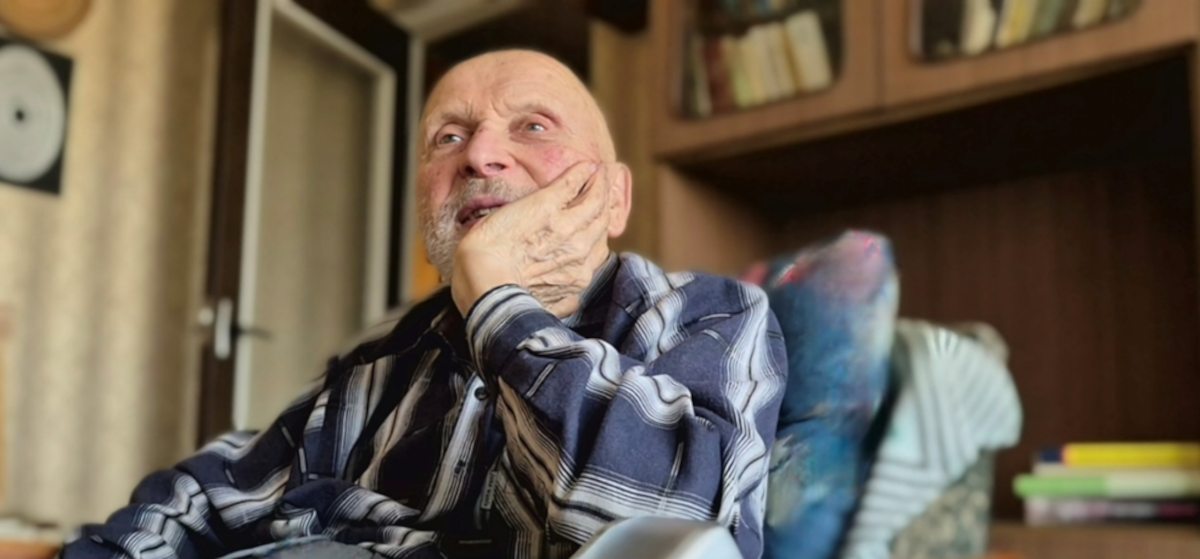
Assoc. prof. dr. Gintautas Grigas
This year marks 45 years since the first programming problems appeared in the Lithuanian press and the Young Programmers' School (JPM) was founded, and 40 years since the systematic teaching of computer science in schools began. One of Lithuania's computing pioneers, the father of informatics education and author of numerous textbooks, Dr Gintautas Grigas – who celebrated his 90th birthday in January – has no doubt: were he choosing his studies today, he would read computer science and specialise in artificial intelligence (AI).
In 2013, Grigas received the Lithuanian Language Prize – awarded for his lifelong work ensuring that computing spoke Lithuanian: from the correct use of the language across all digital tools to the localisation of the most widely used software programmes.
The story of this remarkable computer scientist and educator shows that technological progress begins not with infrastructure, but with curiosity, tenacity and the desire to be of use.
"We built the radio ourselves"
In the 1950s, a curious teenager in the provincial Lithuanian town of Utena – in an occupied and highly censored country – couldn't buy a radio capable of receiving foreign broadcasts – so he built one from scratch with a help of his friends. That radio, cobbled together from handmade parts to pick up the forbidden frequencies of Voice of America, tells you almost everything you need to know about Gintautas Grigas.
Now 90 years old, Grigas remains one of Lithuania's most consequential figures in computing – a pioneer of computer science education, author of more than twenty textbooks, and the man who quietly helped build his country's first homegrown computer – in the face of considerable Soviet disapproval.
In his spare time, he photographs ice crystals and snowflakes, and has exhibited the results in galleries across Lithuania and abroad. The precision required to capture the geometry of freezing water, it turns out, suits his sharp scientific mind perfectly.
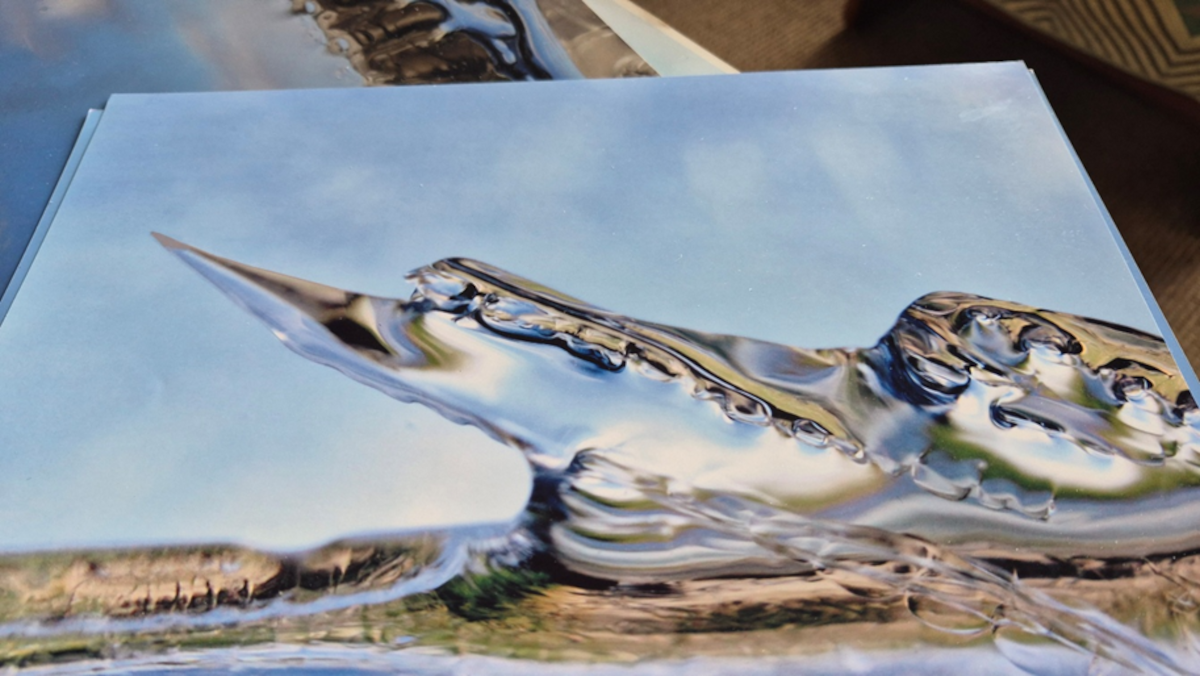
Captivated by the beauty of water and ice
A computer the size of two wardrobes
When Grigas enrolled at the Kaunas Polytechnic Institute in 1954, computers were not yet a field so much as a rumour. He heard about them as a student and was immediately captivated. There were no lecturers, no experts, no literature. He wrote his dissertation largely on his own initiative, and talked his way into a small internship at a computer factory in Moscow. There he finally laid eyes on one – a machine occupying the floor space of a small bedroom, running on roughly 2,000 vacuum tubes.
"About one tube failed every day," he recalls. "The routine was: the machine worked during the day, and at night the engineers sat with it, running maintenance so it would hold together until morning."
This was the technology Lithuania was handed to improve when Grigas arrived at the computing machinery factory in Vilnius.
"We replaced half of the tubes with diodes," Grigas explains. "The tube count halved — which meant reliability should have doubled." A sound improvement. But not, in his view, sufficient. "We felt it wasn't enough. We began building an entirely new computer."
"Rūta": Lithuania's own machine
Rather than simply refurbishing a Soviet copy of an IBM design, the team in Vilnius decided to build something new. Between 1961 and 1962, Grigas led the project that produced „Rūta“ – named after rue (Ruta graveolens), the herb celebrated as Lithuania's national plant – Lithuania's first original computer, replacing the unreliable vacuum tubes with diodes and button-sized ferrite cores, shrinking the failure rate and the price tag simultaneously.
Moscow was not entirely pleased. Objections were raised about memory capacity, design choices, and – tellingly – the Lithuanian name. The local authorities held firm. When a commission eventually arrived from Moscow to conduct formal tests, the Lithuanian engineers were ready for the bureaucratic theatre this required.
"There was a formal requirement that equipment had to operate between +5°C and +30°C," Grigas recalls with visible amusement. "We opened the windows – it was winter – put on our fur coats, and made rather a performance of how terribly cold it was. We'd also brought along a thermometer that was running slightly cool." The machine passed. „Rūta“ went on to be exported across the Eastern Bloc. The Moscow equivalent, built as a response, stayed in local use.
"That is how we got ahead of them," – says Grigas. It would not be the last time.
Teaching a nation to think in code
By the late 1970s, Grigas had turned his attention to a different problem: almost nobody in Lithuania – or indeed in the former Soviet Union – was being taught to programme. Computers were tools operated by specialists, the idea that schoolchildren might learn to write software was largely unexplored.
The seed was planted by academician Laimutis Telksnys – later a driving force behind the country's internet infrastructure – who returned from a visit to a vocational school with a straightforward observation: young people needed something more engaging to do. Grigas began drafting programming problems – not exercises in using computers, but in thinking algorithmically.
In 1981, these problems made their way to Komjaunimo tiesa, the widely read youth newspaper of the day.
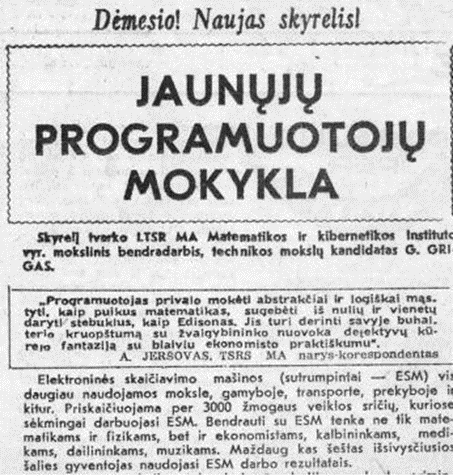
Programming problems in the daily press sparked the interest of thousands
The editorial team was sceptical. The response was overwhelming. Letters poured in from across the country – thousands of them. Grigas notes, with quiet satisfaction, that some were written by parents submitting solutions under their children's names.
The Young Programmers' School (Jaunųjų programuotojų mokykla, or JPM) was formally established that same year, offering a correspondence course built around a fundamental conviction: the goal was not to produce computer users, but computer thinkers – people who could construct and interrogate logical systems, not merely operate them.
A language borrowed from Switzerland
The choice of programming language was itself a minor act of intellectual defiance – not only against the system, but against his own colleagues. The obvious candidate – PL/1, IBM's industry workhorse and the default choice for many at the time – proved, in practice, to be a poor fit. Working through the problems for the school, Grigas found it perfectly adequate for programming, but clumsy and opaque when it came to actually teaching programming. He needed something that would make the logic visible to a beginner's eye.
Grigas settled on Pascal, a language developed in 1970 by Swiss computer scientist Niklaus Wirth and virtually unknown in the Soviet Union at the time. There was no compiler, no teaching materials, and no institutional support.
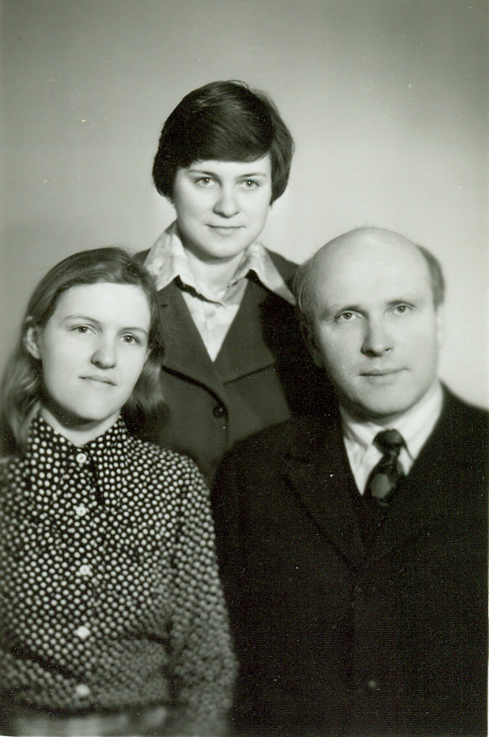
V. Dagienė (née Piekaitė), A. Petrauskienė (née Baliūnaitė) and G. Grigas, creators of the Pascal compiler
Grigas wrote to Wirth directly. A correspondence followed. Wirth supplied a simplified educational variant of Pascal, Grigas and his team proposed enhancements, and Wirth agreed to them. Together with colleagues Alma Petrauskienė and Valentina Dagienė, Grigas built a Pascal compiler from the ground up – giving Lithuanian schoolchildren access to an internationally recognised programming language at a moment when most of their peers elsewhere in the Soviet Union had access to nothing comparable.
One of those students, now Professor Valentina Dagienė, would go on to become a globally recognised authority on computational thinking — and the founder of Bebras (Lithuanian for beaver), the international informatics competition that today draws millions of participants from across the world.
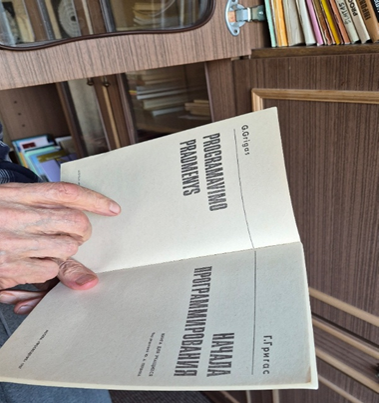
Foundations of Programming by G. Grigas was a bestseller with 250 000 copies
Grigas's textbook Programavimo pradmenys (Foundations of Programming), published in the 1980s, eventually ran to a quarter of a million copies and was read across the Soviet Union.
When two further books were being prepared for translation, Grigas had to fight for a single Lithuanian line on the cover. One publisher proposed omitting any mention that the books had been translated from Lithuanian, suggesting instead that Grigas had written them in Russian in the first place. Grigas declined. "In those days," he recalls, "there was a desire by soviets to create the impression that everything had been invented in Russia."
The question that drives everything
How did a small, occupied nation – devastated by war and genocide, with limited resources – manage to outpace the imperial centre in a field as technically demanding as computing? Grigas's answer is disarmingly simple: it is people and their attitude that matter.
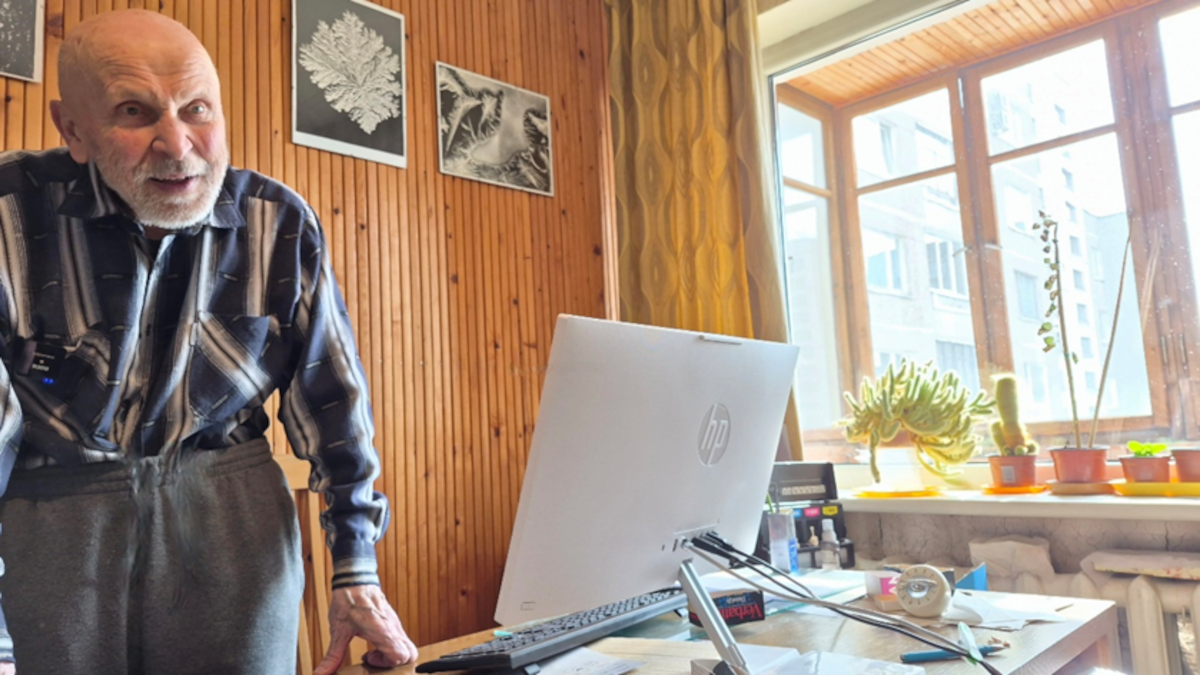
Dr G. Grigas's sun-filled office and his photographs of snowflakes
"My goal has always been to do something useful. When choosing between jobs, I never looked for the highest salary – I looked for where I would be most needed. Twice I deliberately moved to positions with lower pay."
He traces this instinct back to his father, who would read popular science with him as a child and treated curiosity as a shared pursuit rather than a parental obligation. The DIY radio, the self-directed dissertation, the letter to a Swiss computer scientist – all follow the same logic. Identify what is needed. Work out how to provide it. Do not wait for permission or infrastructure.
That philosophy shaped how he ran his own research group, too. Decades before remote working became a matter of organisational policy, Grigas allowed his staff to work from home, convening at the institute just once a week. "I wrote more than twenty books, almost all of them at home," he says. "That's also where I developed the problems for the Young Programmers' School."
Much of this, Grigas insists, was made possible by the directors of the Institute of Mathematics and Cybernetics – now the Institute of Data Science and Digital Technologies at Vilnius University's Faculty of Mathematics and Informatics – professors Vytautas Statulevičius and Mifodijus Sapagovas, who trusted him with the freedom to work as he saw fit.
"They never told me what to do," he recalls. "They supported what I was already doing and helped me make it happen." It is a quiet argument for a particular philosophy of leadership: that between closely supervising a team and finding capable people and stepping back, the entire Lithuanian computing story leaves little doubt as to which approach works.
Still at the frontier
Grigas remains, at 90, an active and mildly competitive observer of the field he helped build. He occasionally uses AI assistants when writing – chiefly, he says, to check how badly they get things wrong. When asked whether university education still matters in an age of AI coding agents, he raises an eyebrow.
"Do you think good programmers will no longer be needed? Did pocket calculators put mathematicians out of work?"
His current projects include an autobiography – which he promises will contain episodes from the early days of Lithuanian computing that have never been made public – and, rather unexpectedly, a science fiction story about artificial intelligence.
Does the story have a happy ending?
"Yes," he says, with a smile. "Well. For some."
1 June 2026
