Mathematics, a slower pace of life, and less chaos – this is how Dr. Daniele Ettore Otera’s life looks today. Originally from Sicily, the Vilnius University Faculty of Mathematics and Informatics (VU MIF) scientist moved to Lithuania thirteen years ago with his Lithuanian wife and decided to stay. According to D. Otera, Vilnius is a great city to raise children. He is fascinated by the greenery of the capital and appreciates the much lower level of bureaucracy compared to his homeland.
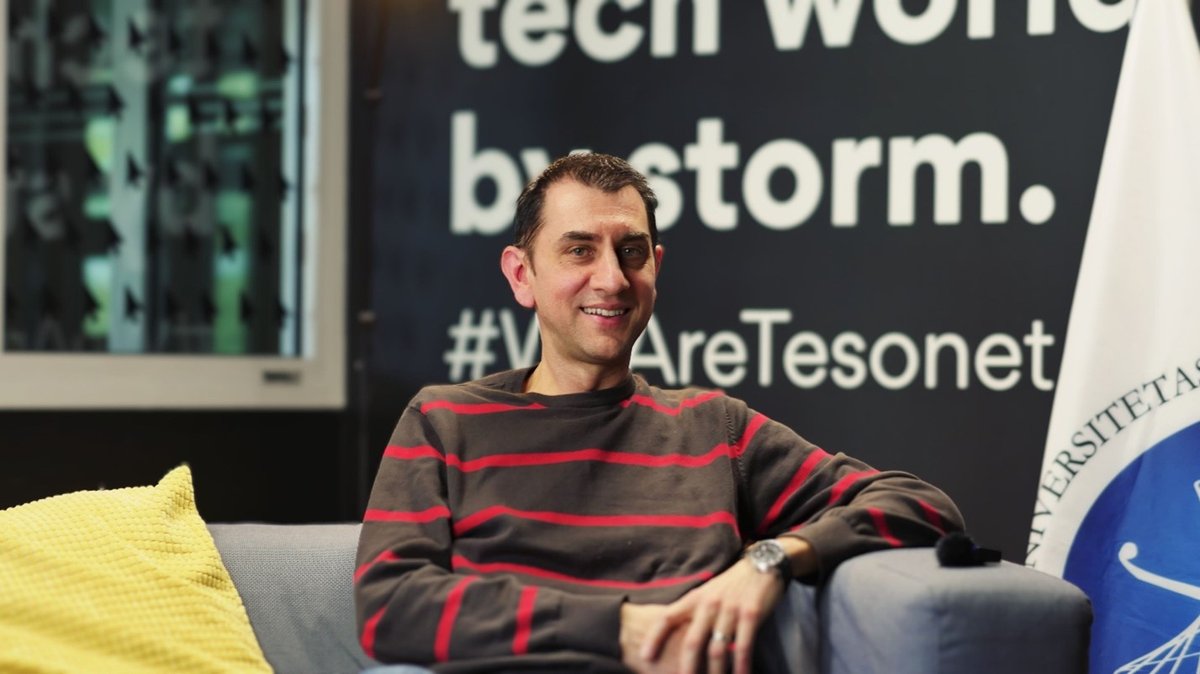
Daniele Ettore Otera. Photo by Vytautas Karpauskas.
From Palermo to Vilnius
D. Otera was born and raised in Palermo – the sunny capital of Sicily, known for its rich history. After studying in Italy, his path led him to France and Switzerland, where he deepened his knowledge in mathematics. However, when his postdoctoral contract at a university in Paris ended, he and his wife had the idea to temporarily move to Lithuania.
“I wanted to learn some Lithuanian and get to know the country better. After a year and a half, I got a job at VU, and we stayed. Now my wife and I are raising two daughters – aged 5 and 10,” says D. Otera. During the summer months, the whole family moves to Sicily: “We spend a lot of time with the grandparents and recharge with sunshine, the sea, the Italian language, and food,” the scientist shares.
First Impressions of Lithuania
D. Otera immediately liked Lithuania: “I was impressed by the greenery and the spaciousness of the city. There are lots of parks in the center, and if you drive just 10 minutes out, you’re in the forest,” the VU researcher recalls his first impressions. He notes that Vilnius is a family-friendly city – full of playgrounds, parks, forests, and lakes. “What’s important to me is that there’s no chaos here, unlike in cities in Sicily,” he says. D. Otera is convinced that living in Vilnius can truly be a unique and exciting experience. “And the cold isn’t as bad as it seems at first,” he smiles.
When asked whether he has encountered stereotypes about Italians, D. Otera says that he has experienced none of that in Lithuania, but admits – stereotypes often contain a grain of truth. Nevertheless, he emphasizes that the most important thing is to get to know the person, not their nationality.
Wishing Lithuanians Smiled More
Having had experience living abroad before coming to Lithuania, the scientist says he’s used to adapting to different cultures, temperaments, and languages. Still, there were some things he had to get used to in Lithuania. “The hardest part was probably communication – both because of the language barrier and differences in personality,” he admits. However, he adds that this stage is already in the past.

Daniele Ettore Otera. Photo by Vytautas Karpauskas.
What he likes about Lithuanians is that most people are respectful and don’t act more important than they are. “On the other hand, I would like it if people here smiled a little more often and talked more. There’s a saying in Sicily that my mother really likes: ‘Shared joy is double joy, and shared sorrow is half the sorrow.’ Lithuanians could be more open about their emotions – both positive and negative,” D. Otera reflects.
He lists Lithuania’s greatest advantages as lower bureaucracy, an efficient public administration system, fewer traffic jams, punctual public transportation, and plenty of natural green spaces.
Inspired to Become a Scientist by His Mother
The researcher at VU MIF specializes in geometric group theory and topology. “I was good at mathematics since school, and during my university years I became particularly interested in topology. What inspired me to pursue a scientific career was my mother’s example – she was a mathematics professor at the University of Palermo,” says D. Otera.
What he values most in a scientific career is the variety of tasks and the freedom to plan his time. “Being a scientist has a huge plus – it’s very diverse: lectures, seminars, conferences, preparing projects, writing scientific papers, reviewing other researchers’ work, and working with students,” D. Otera says, delighted by the dynamic nature of his work.
VU MIF is launching a video interview series featuring Italians who work or study at the faculty. The fourth interview, available in both English and Italian, features features Dr. Daniele Ettore Otera and can be found on the MIF YouTube channel.