
How can Vilnius identify urban problems more quickly and determine which ones need to be addressed first? A team from Vilnius University (VU), SL LAB, developed a technological solution: a prototype app called “Vilkas” (Lithuanian for “wolf“) that combines artificial intelligence (AI), citizen engagement, and gamification. Their innovation earned them first place at the Hack4Vilnius city hackathon, held on 9–11 October 2026.
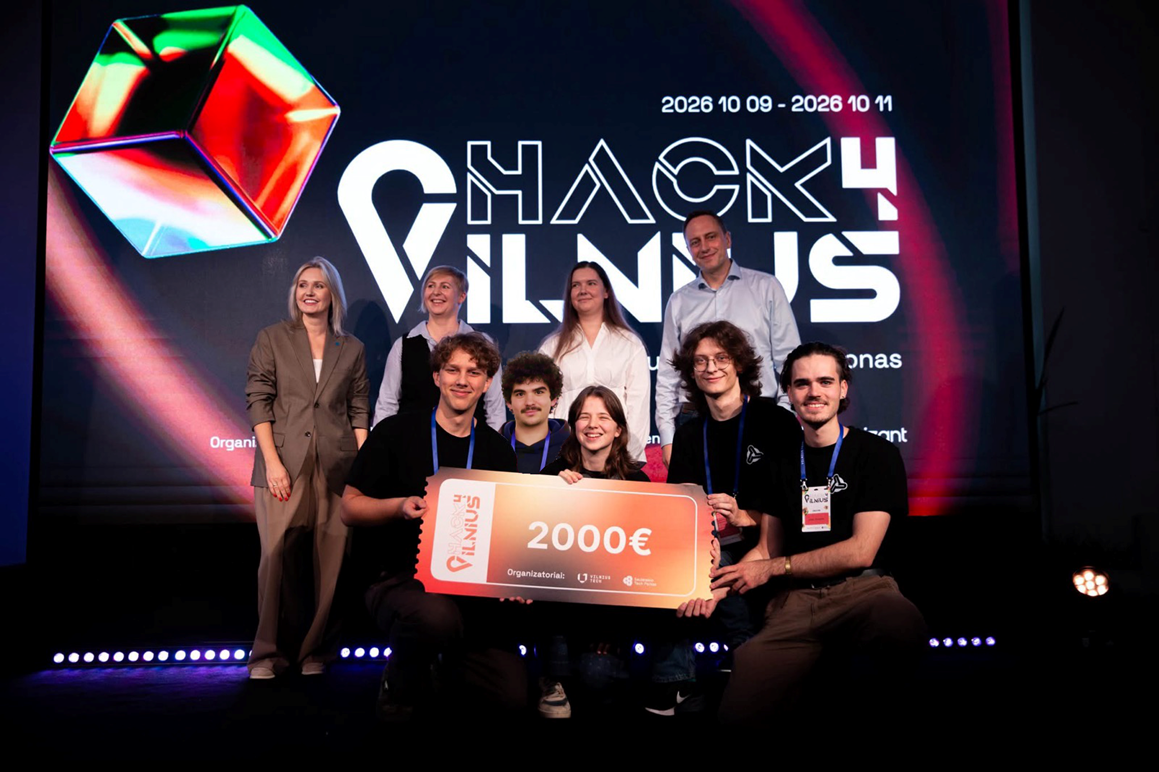
Hack4Vilnius winners SL LAB, pictured with the organizers. Photo: Hack4Vilnius.
SL LAB member Aaron Gandžumian, a third-year Information Systems Engineering student at the VU Faculty of Mathematics and Informatics (VU MIF), is delighted that hackathons offer opportunities not only to test technical knowledge but also to develop solutions to real-world problems. The team hopes that “Vilkas” could eventually reduce the workload of municipal employees and improve how urban problems are addressed.
Growing Through Hackathons
“At first, there were four of us: myself, Lukas Stavaris, who studies Software Engineering, and Marijus Kuprys, who studies Information Systems Engineering – all third-year students at VU MIF – together with Augustas Rinkevičius from the VU Faculty of Chemistry and Geosciences (VU CHGF), who started minor studies in Bioinformatics at MIF this year. In March 2026, we won second place at the Tech_Champ Kaunas hackathon,” recalls Gandžumian. “For the Vilnius hackathon, a fifth member joined us: Augustė Tumaitė, also a third-year Information Systems Engineering student at VU MIF.”
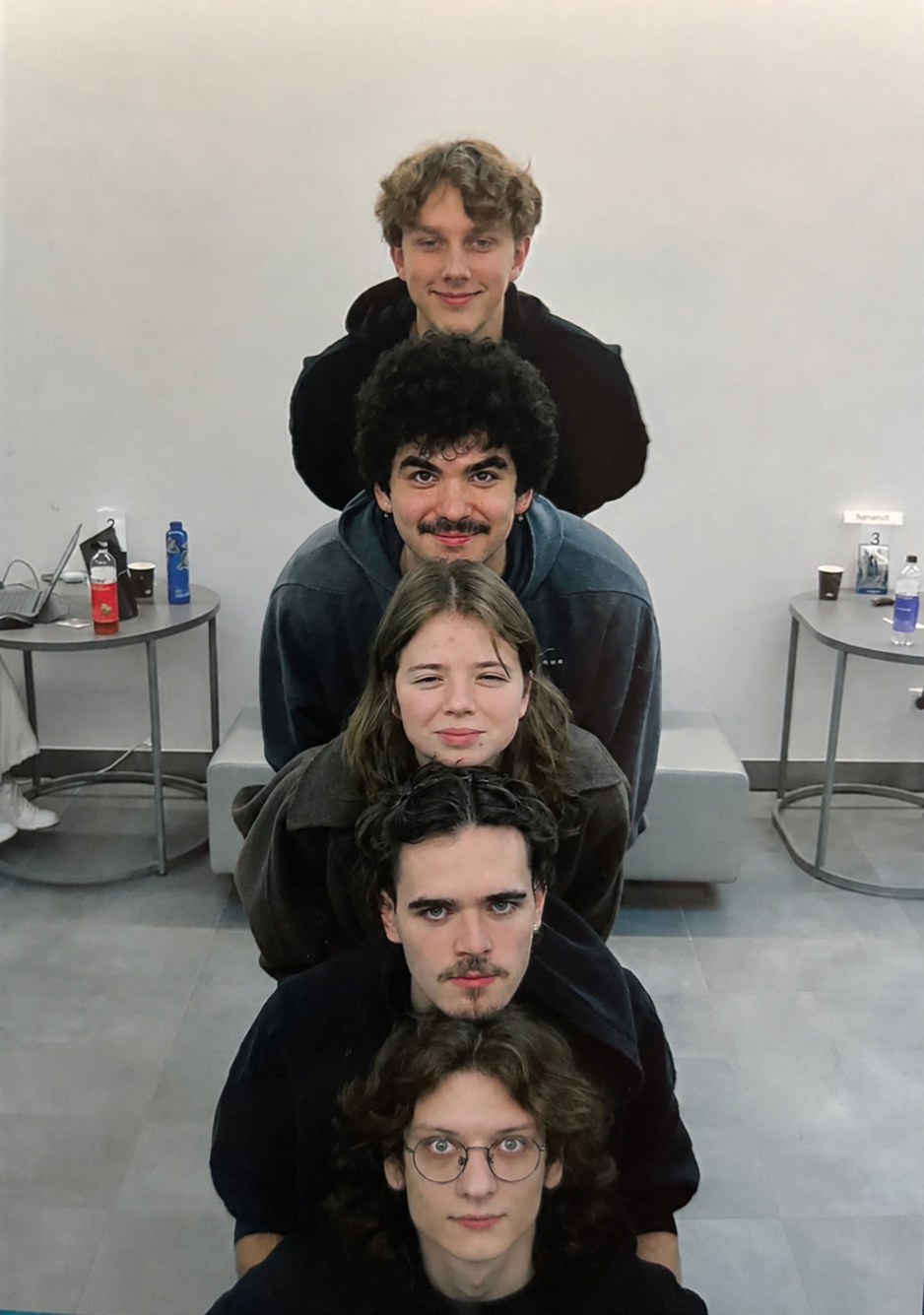
SL LAB
In Vilnius, the VU MIF and VU CHGF buildings on Naugarduko Street are connected by corridors. The students from these faculties who make up SL LAB are united by their shared interest in technology and their desire to put their knowledge into practice.
“We try to take part in as many hackathons as possible. The only practical limit is our health,” the student jokes.
Understanding the Problem Before Developing a Solution
At Hack4Vilnius, the team faced a challenge: how could Vilnius identify urban problems more quickly and determine which to address first?
To develop their solution, the students used open Vilnius city data and consulted mentors. They also contacted the developers of the existing “Tvarkau miestą” (“Fix the City”) platform to better understand the challenges facing the current system.
According to Gandžumian, one of the main challenges in Vilnius today is the large volume of reports submitted by residents, some of which contain duplicate or irrelevant information. Processing these reports takes up staff time, potentially making it more difficult to respond quickly and efficiently.
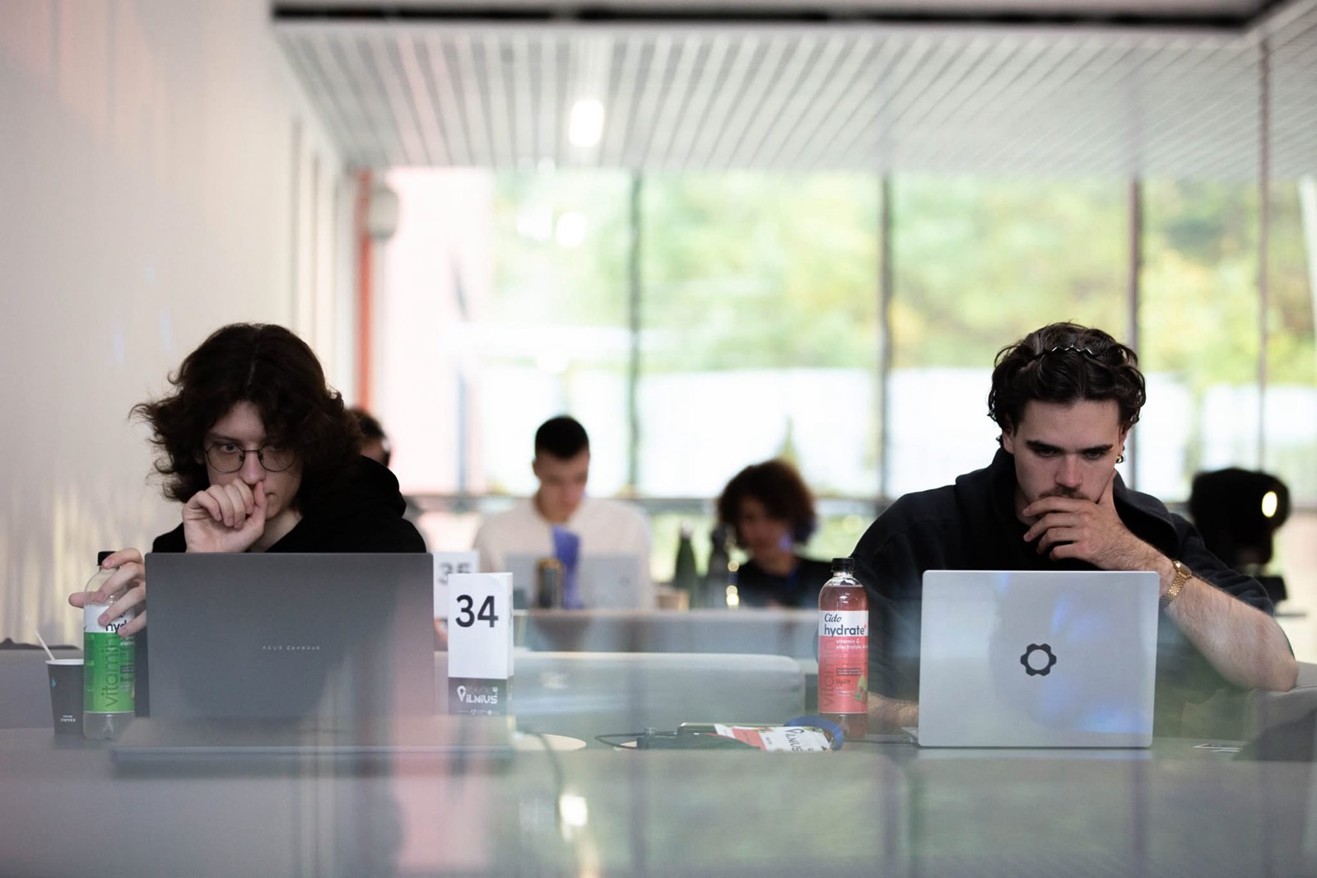
Deep thinking
In roughly 36 hours, the team had to develop an app prototype and prepare a presentation. Three members focused primarily on the technical implementation, while the other two worked on presenting the concept and developing its visual identity.
More Than Just a Problem-Reporting Platform
Skeptics might ask: why create yet another platform for reporting potholes, fallen trees, or illegally parked cars? Wouldn't it be better to spend that time actually fixing the problems?
The hackathon winners argue that a more efficient reporting system could free up valuable time for precisely that purpose.
Residents would be able to report problems they encounter, while other users could confirm them, much like in the navigation app Waze. The system would identify duplicate reports, and each user's reliability score would help assess the quality of the information submitted.
“Residents would earn points and badges for useful contributions and receive discounts from partner businesses, and neighborhoods could compete with one another. This could encourage residents to become more actively involved in improving their surroundings,” explains Gandžumian.
Artificial intelligence would also play an important role in the proposed app. It would analyze residents' reports, suggest categories, assess urgency and reliability, identify potential duplicates, and filter out offensive or inappropriate content.
“Municipal employees would see a list of verified problems ranked by priority on their dashboard. They could monitor trends across different neighborhoods and forward an issue to the responsible authority with a single click,” says a third-year VU MIF student.
What Does It Take to Win a Hackathon?
According to Gandžumian, whose team has now won prizes at two hackathons, success requires more than technical expertise. The ability to define a problem clearly and justify the proposed solution is equally important.
“The mentors' insights, the productive environment created by the organizers, and the support of friends and fellow students who helped test the platform and took part in our quantitative market research were all valuable to our team,” he says.
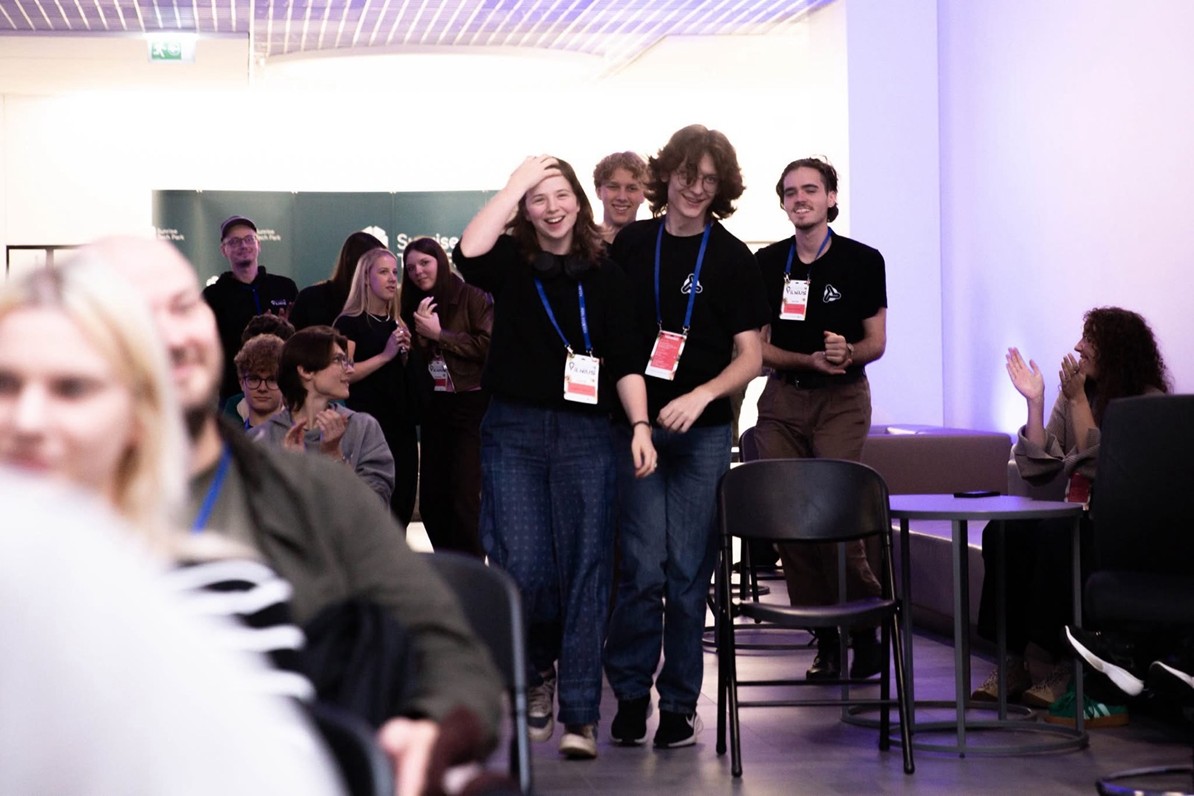
This is what victory looks like!
For VU MIF students, hackathons provide opportunities to develop teamwork skills, make decisions under time pressure and apply the knowledge gained during their studies. They also offer a chance to discover whether a technological idea can make a difference beyond the university.
“We gain extremely valuable technical and soft skills that will help us contribute to Lithuania's well-being,” says Gandžumian, reflecting on the benefits of such events.
Will Wolf Make Its Voice Heard?
For now, “Vilkas” remains an app prototype, but the team hopes the idea can evolve into a fully developed product.
“We hope to collaborate with Vilnius City Municipality and develop Vilkas into a fully functional application,” says Gandžumian.
30 October 2026
